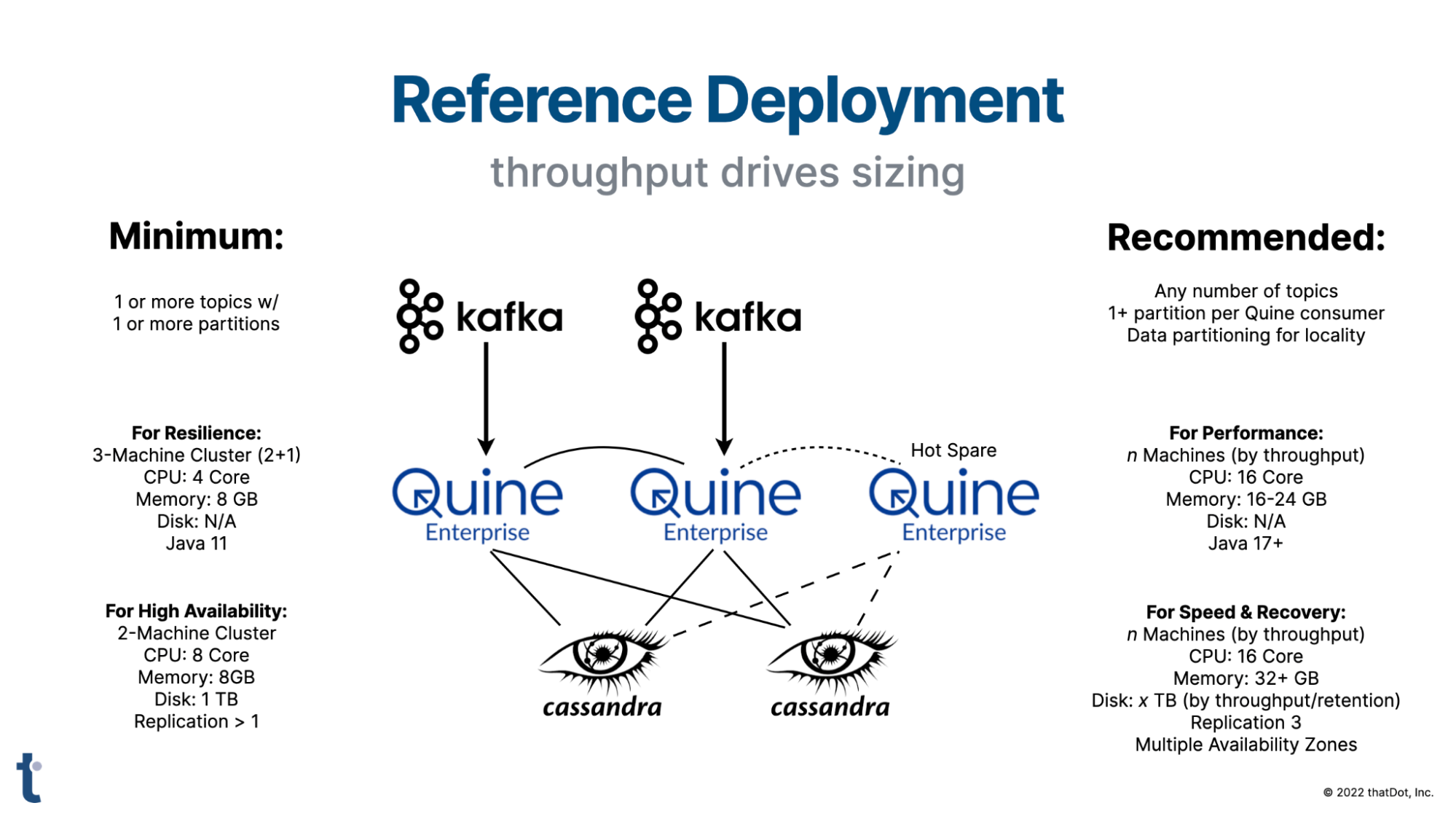
Recommended Operating Environment
| Component | Recommendation |
|---|---|
| Cluster Size | Sized according to throughput needs — see Cluster Sizing |
| Operating System | Ubuntu 22.04 LTS (recommended) |
| Quine Enterprise Java | OpenJDK or Oracle 21 (requires at least 17) |
| Quine Enterprise CPU | 8-32 Cores Recommended |
| Quine Enterprise Memory | 16-20 GB RAM |
| Cassandra Java | OpenJDK or Oracle 11 (or 8) |
| Cassandra CPU | 16+ Cores |
| Cassandra Memory | 32+ GB RAM; high memory instances are recommended |
EC2 instance‑type guidance
Use fixed‑performance instances such as the m7a family for production clusters.
m7a nodes deliver sustained vCPU capacity.
Avoid burstable t‑series (t3, t4g, etc.) in production.
These instances rely on CPU‑credit buckets: once the credit balance is depleted, the vCPUs are throttled down to their low baseline (for example, about 30% of a core), causing sudden latency spikes and reduced throughput.
Burstable nodes are fine for ad‑hoc testing or dev workloads that idle most of the time, but Quine Enterprise's stream‑processing benefits from guaranteed compute.
Cluster clock synchronization
Important! System clocks should be synchronized between cluster members.
See Clock Synchronization for more details.